
From CEO to shop floor management
People & Organization
We design roles, governance, decision paths and ways of working that create clarity, speed and accountability. Our focus is not only how the organisation should look, but how people will lead, collaborate and perform within it.
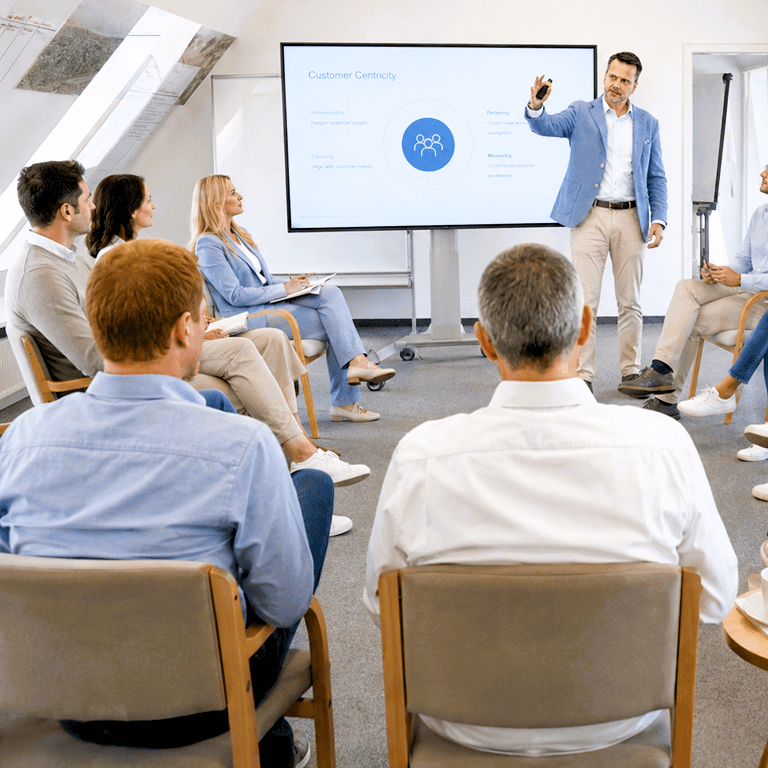
We help you build organizations people can perform within
Successful businesses have a strategy as well as all the necessary resources and competencies to implement it effectively. Smart processes and structures ensure effectiveness and efficiency. These organizations also make decisions quickly because they have clearly defined roles and authorities. Added to this is a culture among the workforce that encourages people to take responsibility and a constant desire to improve the organization and develop further.
Unfortunately, it is rare for all these characteristics of successful businesses to be true. Instead, everyday operations are often marked by slow decision-making, unclear authorities and roles, duplication of effort, a lack of willingness to take responsibility, skill gaps, and a lack of adaptability.
Our proven approach
viadoo combines organizational design with the ability to drive implementation. We consider both the formal organization and the reality on the ground: structures, processes, and governance on the one hand; leadership, behavior, collaboration, and culture on the other.
Together with you, we create a clear vision and translate it into specific roles, decision-making pathways, processes, leadership routines, and implementation measures. In doing so, we work closely with leaders, teams, and key individuals so that your initiatives become effective.
Our goal: organizations that function efficiently, make decisions faster, and are supported by the people who are actually doing the work.
As with all our services, we take a structured approach to organizational consulting and organizational design. Our four-phase model includes:
Analyze of your organization’s strengths and weaknesses with you
Analyze of stakeholders und potential impact on them with you
Design of modified operating model, governance, decision matrix
Implementation of initiatives jointly with your teams to make them last
Our services in people & organization
With People & Organization, we bring structures, processes, roles, decision-making pathways, leadership, and collaboration into clear alignment.
1
Operating model & Organizational design
We analyze how your organization actually works today and where it is hindering strategy, growth, or transformation. Together with you, we develop an operating model that clearly aligns structures, roles, processes, governance, and management. In this way, we reduce friction, duplication of effort, and interface issues.
2
Decisions & Governance
Slow decision-making often stems from unclear responsibilities, overburdened committees, or a lack of accountability. We identify the decisions critical to your company’s success and clarify who prepares them, who makes them, who is involved, and how implementation is ensured.
3
Roles, responsibilities & collaboration
We provide clarity on which roles, mandates, and responsibilities are needed in your organization. In doing so, we consider not only formal structures but also actual day-to-day collaboration. This results in clear lines of responsibility, fewer coordination loops, and greater personal accountability among leadership and teams.
4
Leadership, behavior & competencies
New structures only work if leadership and behavior align with them. That’s why we support leaders and employees in embracing new roles, taking on responsibility, and establishing effective work routines. We identify competency gaps, develop appropriate leadership and collaboration models, and strengthen the organization’s ability to evolve over the long term.
Featured success stories


Ready to discuss your business opportunities?
Top 6 advantages of external organizational consultants
Objective outside perspective
External organizational consultants see patterns, conflicts, inefficiencies, and blind spots that internal teams may no longer notice.
Clearer decision-making
They help define roles, responsibilities, governance, escalation paths, and decision rights so the organization works with less friction.
Faster transformation
External consultants bring proven methods, tools, and experience from other organizations, which can speed up diagnosis, design, and implementation.
Better alignment
They know how to translate business strategy into a practical target operating model (TOM): structures, processes, capabilities, KPIs, and ways of working.
Higher acceptance among people
A strong organizational consultant supports executives and employees through the change, manages resistance, and helps make the new organization actually work in practice.
Reduced internal bias
Sensitive topics such as power shifts, role changes, restructuring, or accountability gaps can be addressed more objectively by external organizational consultans.
Frequently asked questions
Organizational consulting helps companies build the right structures, processes, roles, and ways of working so people can deliver better results. It often includes topics like organizational design, operating models, governance, leadership, collaboration, transformation, restructuring, and change management. Most important: people need to understand, accept, and live any new setup. That is where the human side becomes decisive.
Organizational design is the deliberate shaping of how a company is structured and how work gets done. It defines things like roles, responsibilities, decision rights, reporting lines, processes, governance, collaboration models, and sometimes even culture and leadership routines. The result is usually a clear target operating model.
| Method | What it is used for |
|---|---|
| Strategy alignment | Translating business strategy into required organizational capabilities, structures, and priorities |
| Operating model design | Defining how the organization should work across structure, processes, governance, people, technology, and performance |
| Organizational diagnostics | Analyzing what currently works and what blocks performance, for example unclear roles, slow decisions, silos, or overload |
| Process mapping | Visualizing how work flows through the organization and where interfaces or inefficiencies exist |
| Role and responsibility design | Clarifying who does what, who owns which result, and where accountability sits |
| RACI / decision-rights matrix | Defining who is responsible, accountable, consulted, and informed for key activities and decisions |
| Governance design | Creating decision forums, escalation paths, meeting structures, and steering routines |
| Capability mapping | Identifying which skills, capacities, and leadership capabilities the organization needs |
| Org structure design | Designing departments, teams, reporting lines, spans of control, and layers |
| Stakeholder analysis | Understanding who is affected by the new design and how to involve or communicate with them |
| Workshops and co-creation | Developing the design together with leaders, employees, and key stakeholders |
| Change impact assessment | Assessing how the new design affects people, roles, processes, systems, and culture |
A target operating model (TOM) is a blueprint for how an organization should work in the future. The final output is often a combination of documents: an org design, role descriptions, process maps, governance model, decision matrix, capability model, KPI framework, and implementation roadmap.
A governance model defines how an organization makes decisions, assigns accountability, escalates issues, and controls performance. Designing a governance model means defining the key decision areas, clarifying decision rights, setting up the relevant governance bodies, determining cadence, inputs and outputs, and establishing a clear escalation logic.
Request for quote now!
Discuss your challenges and opportunities
Whether you’re exploring a challenge or ready for a full diagnosis — we’re here to listen. No bots — just a real expert ready to talk.