


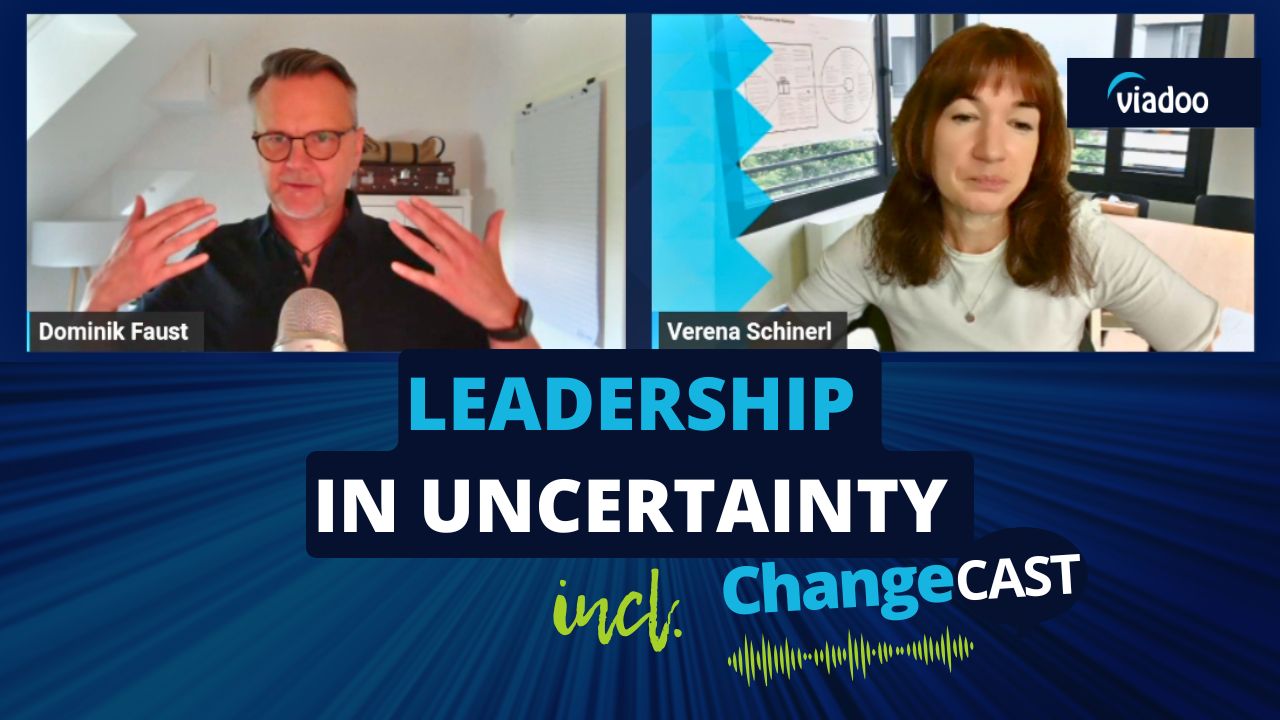
The German leadership debate thrives on contrasts. For years, organizations considered the empathetic, approachable, and coaching-oriented leader the ideal. Now the pendulum seems to be swinging back: In the face of economic stagnation, geopolitical uncertainty, technological disruption, and painful restructuring, there is suddenly talk of a “new toughness.” So do Germany’s companies now need tougher leaders? That question doesn’t go far enough. Because in crises and complex situations, organizations need leaders that understand people, make decisions, and consistently ensure that employees carry them out. In the latest episode of our podcast, we take a closer look at leadership in uncertainty.
Empathy OR toughness?
We’re examining a leadership challenge that many board members, CEOs, and division heads are currently facing firsthand: Their shareholder expect them to provide direction even though key developments are virtually impossible to predict with any degree of reliability.
Markets are changing. Costs must be reduced. Business models are being challenged by artificial intelligence. At the same time, customers expect companies to become more innovative, faster, and more resilient. Leaders must make decisions before they have all the information at their disposal.
In this situation, two ways of leadership in uncertainty seem tempting.
- The first is to resort to authority: less discussion, tighter control, and tougher directives.
- The second is to listen for as long as possible, show understanding, and postpone decisions so as not to overwhelm or alienate anyone.
Both reactions can provide short-term relief. However, neither solves the leadership problem.
Authoritarian rigidity often reduces complexity only in appearance. Information is withheld, risks are escalated too late, and necessary criticism is silenced.
Empathy without decision-making, on the other hand, leads to ambiguity. While employees are heard, they still do not know what the rules are, what is expected of them, or which priorities actually matter.
The viadoo position is therefore clear:
Empathy without consistency becomes noncommittal.
Consistency without empathy becomes intimidation.
Confident leadership in uncertainty combines both.
Uncertainty cannot be eliminated
Leaders cannot eliminate uncertainty. However, they can prevent uncertainty from turning into a loss of direction by clarifying the varying degrees of certainty. After all, in uncertain situations, organizations need a robust decision-making framework, clearly assigned responsibilities, and leaders who exude confidence without denying the existing uncertainty.
Questionnaire for leaders
Which facts are reliable?
What economic, technical, or regulatory conditions apply?
Which assumptions need to be verified?
What developments are we monitoring?
When do we expect new information?
What is our strategic direction?
Which investments are being prioritized?
Which activities are being halted?
What responsibilities does the board of directors bear?
What responsibilities does senior management bear?
What responsibilities does the project organization bear?
What results must be available by when?
Empathy is a management tool
Leaders often confuse empathy with niceness, leniency, or a need for harmony.
However, empathy first and foremost means being able to understand other perspectives. For leadership in uncertainty, it is therefore a vital source of insight: How will an organization interpret a decision? Where might legitimate objections arise? What conflicts of interest can be expected? What informal power structures influence implementation? Which key individuals are at risk of losing buy-in?
This information is business-critical. It determines whether executives put a new operating model actually into practice, integrate a merger, implement a turnaround program, or adopt a new technology. Cognitive empathy thus helps to understand different perspectives, build trust, bring conflicts to light, and more effectively motivate people to participate in an initiative.
Empathy therefore improves the quality of executives’ decisions and increases their feasibility.
Consistency does not mean toughness
Just as often, employees confuse consistency with personal harshness and vice versa. For some executives, leadership in uncertainty then means, to act particularly harshly, to publicly punish mistakes, or to treat employees as interchangeable cost items.
However, leaders demonstrate true consistency when they:
- set a few, clear priorities (to avoid change fatigue),
- resolve conflicting goals,
- clearly assign responsibilities,
- transparently monitor progress,
- address deviations early on,
- offer support,
- and take action when implementation consistently fails to materialize (e.g., by halting or postponing individual projects).
In this sense, firmness is the willingness to defend priorities against competing interests.
Leadership must endure contradictions
The current reality for many leaders is managing constant areas of tension: stability versus agility, control versus empowerment, automation versus the expansion of human capabilities.
Successful leadership must strike the right balance depending on the situation. This is precisely where the weakness of the debate over a so-called “new toughness” lies. For it gives the impression that leadership must choose one side:
- Closeness or distance.
- Participation or decisive action.
- Trust or control.
- Empathy or performance.
In practice, however, organizations need both – though not always at the same time and not to the same degree.
In an acute liquidity crisis, management must centralize and accelerate decision-making. When developing a new business model, on the other hand, the expertise of decentralized teams is indispensable. In a restructuring, the target metrics and timeframe may be fixed. Nevertheless, the specific design of processes, roles, or collaboration can be developed jointly.
What matters most is that leaders make clear which parts of a project they have already decided and where there is genuine scope for input. Those who promise participation even though the outcome has long been determined are engaging in token participation. Conversely, those who make every implementation decision centrally squander expertise and generate unnecessary resistance.
A model für leadership in uncertainty
From our podcast, we can distill five requirements for confident leadership practice.
1. Guidance before reassurance
Employees do not expect a leader to foresee every future development. However, they do expect a clear assessment of the situation and answers to questions such as these:
- What happened?
- What does this mean for our business?
- What options have we considered?
- Why did we choose this path?
2. Listen first, then decide
Dialogue improves decision-making when it takes place early enough and yields concrete insights. However, it must not become an endless loop. The leader must make it clear when information will be gathered, who will ultimately make the decision, and by when the decision will be made.
3. Clarity on expectations
In many projects, there is intense discussion about vision statements, but too little about concrete expectations. Here, too, employees expect answers to specific questions:
What behaviors should they adopt?
What behaviors should they discontinue?
Which old tasks should they eliminate?
- How will executives meassure implementation?
- What happens if agreements are not honored?
4. Respect in interactions
A leader can identify a performance as inadequate without devaluing the person. They can close a department while openly discussing the consequences for those affected. They can take resistance seriously without fulfilling every demand.
The line is not drawn between empathy and strictness, but between responsible leadership and disrespectful behavior.
5. No responsibility delegation
Anyone who wants to lead projects or programs effectively must bear sole responsibility for them and must set the direction, priorities, and consequences. HR, Communications, or Change Management can provide valuable support during implementation by analyzing, advising, training, and facilitating.
Conclusion to leadership in uncertainty
In the current situation, German corporations do not need authoritarian bosses who interpret dissent as disloyalty, hide insecurity behind grand gestures, and confuse assertiveness with intimidation.
Rather, German companies need confident leaders who demonstrate these skills: .
- They listen first and then decide.
- They explain and expect implementation.
- They show understanding and set boundaries.
- They delegate responsibility and monitor results.
- They remain respectful while still holding people accountable.
ChangeCAST episode (Video)
In this episode of the viadoo ChangeCAST, we both discuss leadership in uncertainty and the necessary combination of empathy and toughness—or consistency. The focus is on how leaders can remain capable of taking action even in critical situations. We also demonstrate why empathetic leadership is not the opposite of performance and actually leads to better decisions. Watch now and learn why leaders don’t need to be tougher on people – but rather more consistent in their leadership.
Author(s)

Dr. Dominik Faust verfügt über langjährige operative Führungserfahrung (>70 MA) mit P&L-Verantwortung (>6 Mio. €). Er ist Kommunikationsprofi mit der Dreifach-Perspektive eines Journalisten & Autors, eines Leiters Corporate Communications & Pressesprechers sowie eines Medienmanagers. Zudem ist er zertifizierter Change Manager und Großgruppenmoderator. Als Top-Management-Berater unterstützt er seit vielen Jahren KMUs und DAX-Konzerne bei der Planung und erfolgreichen Steuerung komplexer Projekte bzw. Transformationsvorhaben. Seine Erfahrungen teilt er hier im Blog.

Verena holds a degree in psychology from Karl Franzens University in Graz (Austria). And she is a trained systemic coach, certified by the Institute for Applied Psychology, University of Cologne (Germany). She guides organisations successfully through changes related to personnel, culture and processes. Verena is also an editor of the viadoo blog. She contributes on the psychological aspects of change projects.


