

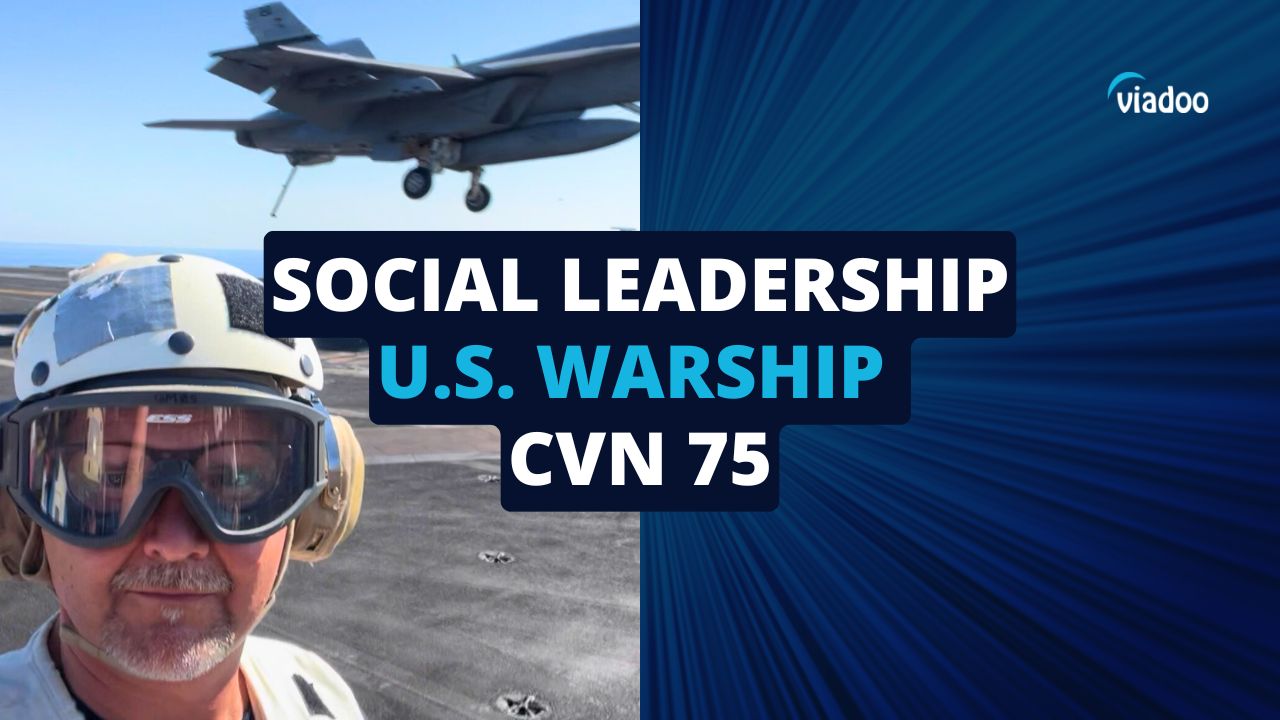
An aircraft carrier is a high-performance social system: up to 5,000 people often live and work in confined spaces for months on end. This extreme situation reveals how leadership deals with group processes and human dynamics. The captain is at the center of a system that would quickly become dysfunctional without targeted social leadership. CEOs can also learn from this. Even though there is a clear difference to the civilian world: the military leadership principle is based on power through rank and role, as well as the military functional principle of command and obedience that builds on this. viadoo founder Dominik Faust, himself a long-time press officer (reserve) for the German Armed Forces, recently spent almost a week on the aircraft carrier Harry S. Truman (CVN 75) as part of a volunteer troop support program for the U.S. Navy. He shares his impressions with us.
Table of contents:
1. No daylight for days
Somewhere in the Mediterranean, the nuclear-powered Nimitz-class ship with a standard displacement of 97,000 tons is cruising. It is at the center of the multifunctional U.S. Navy CSG-8 task force and belongs to Naval Air Force Atlantic (AIRLANT). There are over 5,000 men and women on board. Slightly less than half of them maintain 24/7 flight operations with nearly 70 aircraft (primarily F/A-18E Super Hornets) in cycles. The other half work almost exclusively in areas below deck. These extend over ten floors below the waterline. They do not see daylight for days on end.
The ship’s crew is housed in a total of 2,700 cabins. The flying personnel (Air Wings) have their quarters directly below the flight deck, the rest below that. Officers enjoy the privilege of “double rooms” in the form of bunk beds, while enlisted personnel have to be satisfied with three-tier bunks in dormitories. The nearly 20,000 meals served daily are also eaten by executives and staff members in separate and differently equipped messes (dining rooms). These privileges for officers symbolize the hierarchical system of the aircraft carrier very impressively.
2. The aircraft carrier as a social system
The carrier is a closed microcosm, a kind of “social laboratory under full load”: hierarchies are clear, roles are defined, and decision-making processes are efficient. But beneath this surface, informal systems are at work. In social psychological terms, the needs for autonomy, competence, social belonging, and status (Deci & Ryan, Goleman, Tajfel) remain central even in a military context. A ship of this size in particular is characterized by ingroup/outgroup dynamics. Crew members like to identify with their department, which is also visually visible.
For example, the “hookup men” (who operate the catapults on deck) and the maintenance personnel wear green, the ‘shooters’ wear yellow, the fuel personnel wear purple (“grapes”), and the weapons experts wear red. In addition, there are petty officers (PO) with different specializations, who can be identified by badges on their uniforms. Among others, there are administrative, medical, or dental POs, ship technical POs, and POs for flight operations personnel.
3. Social cohesion through interdisciplinary teams
Against this backdrop, it becomes clear that executives on aircraft carriers must consciously create cross-group identities and prioritize community over function. This is because functional silos always lead to misunderstandings and rivalries: pilots versus maintenance personnel, engineering versus administration, officers versus enlisted personnel. Awakening and, above all, maintaining a sense of unity is important on aircraft carriers, but also in post-merger integrations, for example.
Social leadership therefore ensures social cohesion through team identity across departmental boundaries. This also determines the success or failure of change projects. The existence of interdisciplinary units helps the leadership personnel on the aircraft carrier. For example, the flight deck crew is divided into teams made up of different functionaries. These are visually distinguished by the colored deck jerseys mentioned above.
4. Social identity through rituals and narratives
Emotional attachment to an organization or social identity is not a luxury, but crucial for the motivation and commitment of a team. They are strategic tools for cultural development. Emotional attachment is even vital for the effectiveness of any military organization – including and especially that of the aircraft carrier weapon system. Rituals, symbols, and narratives serve this purpose.
5. Internal Comms as a management tool
The (internal) communications department is responsible for the identity-forming narrative in organizations. I was jointly responsible for external and internal communications in various Bundeswehr units for many years. This included external media relations as well as the publication of traditional (internal) field newspapers for soldiers during large-scale exercises.
There is also a press and information center on board the USS Harry S. Truman. The comrades there produce TV programs that they regularly broadcast on TV sets in the cabins. They also post photos on Instagram and other social channels almost daily and produce printed newsletters and magazines. The latter are available in the mess halls, for example.
The captain (at that time: Gavin Duff) addresses his crew daily with an live audio message that is broadcast to the cabins via loudspeakers. He selects a “Sailor of the Day” and uses his transparent communication to prevent rumors. There is also a small museum commemorating the ship’s namesake, President Harry S. Truman, as well as the tradition and values that the crew is always ready to fight for (“Give ’em Hell!“).
With all these and other communication measures, the captain and his leadership team promote trust, transparency, social cohesion, and social identity.
6. Mental stability through leisure activities
Everyday life on board is monotonous, cramped, and noisy. Added to this is the months-long separation from their families. The psychological stress level for the sailors is high. To keep the structure stable, there are rules of conduct for peaceful coexistence and dispute resolution. Above all, however, there are around a dozen gyms or workout areas on the huge ship. For spiritual well-being, priests on board offer daily services for various denominations in a room that can be quickly converted depending on the religion. Of course they have a library and a movie theater.
Volonteer driven BBQ for 5000 sailors
And sometimes, with the approval of the U.S. Navy and the captain, volunteers come on board at their own expense. As “Steak Team Mission,” we had thousands of original T-bone steaks from Texas chewed and flown in. The night before, we thawed them in a commercial kitchen and prepared all kinds of BBQ side dishes on a grand scale. The next day, we grilled for 5,000 men and women on the 1.8-hectare flight deck and hosted a gigantic BBQ. The captain also ordered the first swimm day of the mission. In this way, we gave the sailors an unforgettable day that had a lasting effect on morale and mental stability (see video).
Such offers and events have an emotionally relieving effect, connect people across hierarchies, and strengthen the feeling of autonomy and freedom of choice. They prevent social erosion i.e., the creeping retreat into private life, passive conformity, or inner resignation.
7. Conclusion on social leadership
Whether aircraft carriers or companies: organizations are social systems. Anyone who wants to bring about change in them must nurture these systems – through social cohesion, social identity, effective communication, and psychological stability. Today, leadership means not only making decisions, but also shaping relationships.

Author(s)

Dr. Dominik Faust verfügt über umfassende Erfahrung in der Führung komplexer, funktionsübergreifender Initiativen an der Schnittstelle von Transformation, Governance und Kommunikation (P&L-Verantwortung > 6 Mio. €). Als Gründer der viadoo GmbH unterstützt er seit vielen Jahren Führungskräfte aus KMUs und DAX-Konzernen operativ bei der Planung und erfolgreichen Steuerung anspruchsvoller Projekte. Dazu gehören M&As (Post-Merger Integration), Restrukturierungen oder Projekt-Recovery.