

Just a few weeks ago, banks and insurance companies weren’t willing to invest a single penny in the defense industry. That’s because the European Commission plans to place these companies on a blacklist of socially harmful and therefore unsustainable businesses. But Putin’s campaign against Ukraine has turned the tide. Institutional investors are once again showing interest in the stocks of Rheinmetall, Hensold & Co. At the International Aerospace Exhibition (ILA) currently taking place in Berlin, companies in the security and defense industry are receiving significant media and professional attention from both Germany and abroad. The largest single exhibitor is the German Armed Forces (Air Force), which, according to its own statements, is presenting 27 weapons systems. Companies in the security and defense industry still generate over twelve billion euros annually in direct gross value added in this country and directly employ over 135,000 people.
Is defense industry socially unsustainable?
However, the industry in Germany experienced a sharp decline in the 1990s and 2000s and has been stagnating for several years, with a continuing slight downward trend. Much of the expertise has migrated to other European countries. Now, the remaining 220 or so companies still in Germany are also on the brink. The reason is an issue that has become the second-largest driver of transformation after digitalization: sustainability. As is well known, companies’ sustainable practices are evaluated based on environmental, social, and governance (ESG) criteria. While environmental criteria can largely be defined objectively, social criteria are also subject to subjective assessments.
According to their association, the BDSV, companies in the defense industry have long struggled with banks denying them loans because they classify them as socially harmful and thus unsustainable. BDSV President and CEO of Rheinmetall, Armin Papperger, even speaks of “a large number of banks and investment funds in Germany” that “have decided on their own, in the spirit of a business policy focused on sustainability, to no longer serve customers dedicated to equipping our security agencies and armed forces.” Even state-owned banks such as the Bayerische Landesbank cite their own (subjective) assessments as well as the poor rating of social compatibility by the so-called “Platform for Sustainable Finance.”
There is no sustainability without security
The latter is a standing expert panel of the European Commission. It is composed of institutional representatives, experts from financial and non-financial markets, civil society, and research institutions. The panel has placed companies in the defense industry on a negative list under the aspect of social taxonomy. The BDSV rejects this stigmatization. “By equipping the military and security forces, our companies make a fundamental contribution to the external and internal security of the Federal Republic of Germany,” states a recent paper (“Peace – Safety – Sustainability”) by the association.
The fact that sustainability cannot exist without security is demonstrated very impressively by Russia’s attack on Ukraine, which began two years ago and violates international law. Many people in Europe have lost sight of this connection in recent decades. This includes people who today sit on committees deliberating criteria for social sustainability. Their task is important. But perhaps they should occasionally seek expertise they themselves lack. Executives at the major Swedish bank SEB have evidently done so. Shortly after the start of the war in Russia, the bank lifted its self-imposed ban on investments in weapons.
Defense industry at the ILA through sunday
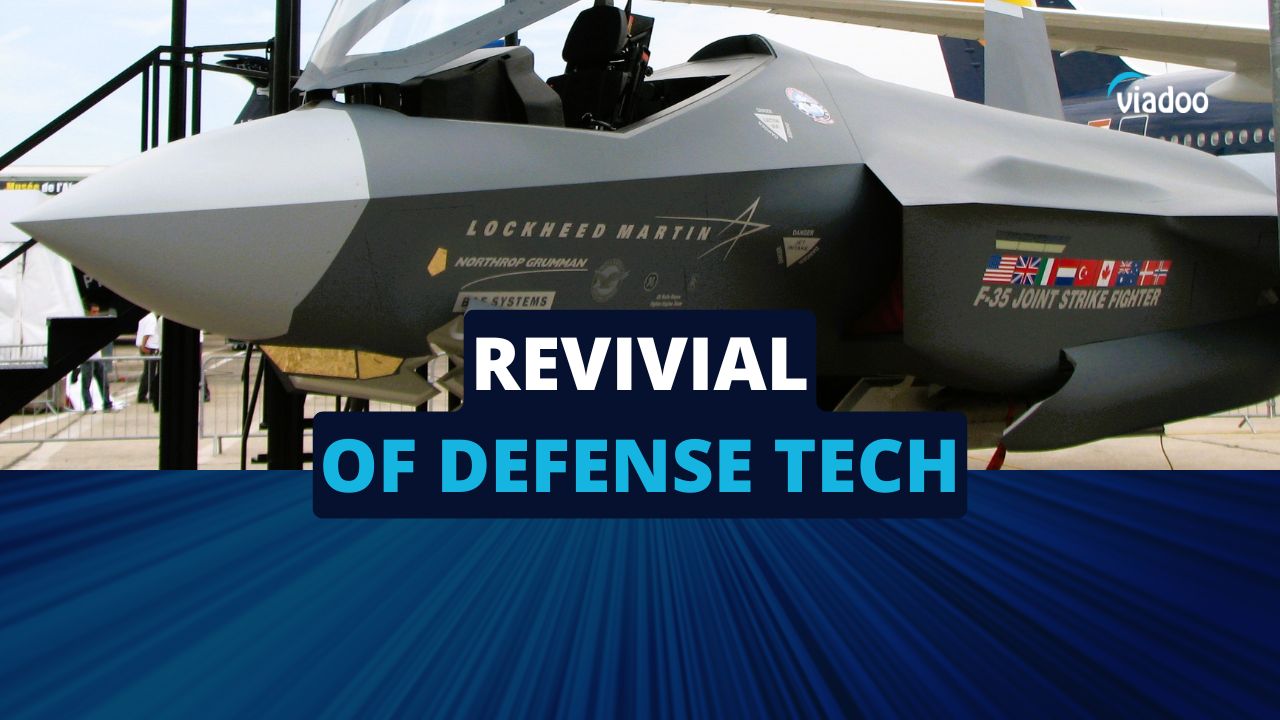
Perhaps a few more executives from banks and insurance companies can be convinced of this at this year’s ILA in Berlin. The 550 exhibitors from 29 nations will certainly be happy to engage in discussions and provide live demonstrations. Lockheed Martin, by the way, is on site with the F-35 stealth multi-role fighter jet. The German Armed Forces plans to replace its old Tornados with this aircraft using funds from the 100-billion-euro special fund. The cover photo shows an F-35 model that Lockheed presented at the 2007 Paris Air Show in Le Bourget.
Picture: © Faust / viadoo GmbH
Author(s)

Dr. Dominik Faust verfügt über umfassende Erfahrung in der Führung komplexer, funktionsübergreifender Initiativen an der Schnittstelle von Transformation, Governance und Kommunikation (P&L-Verantwortung > 6 Mio. €). Als Gründer der viadoo GmbH unterstützt er seit vielen Jahren Führungskräfte aus KMUs und DAX-Konzernen operativ bei der Planung und erfolgreichen Steuerung anspruchsvoller Projekte. Dazu gehören M&As (Post-Merger Integration), Restrukturierungen oder Projekt-Recovery.