

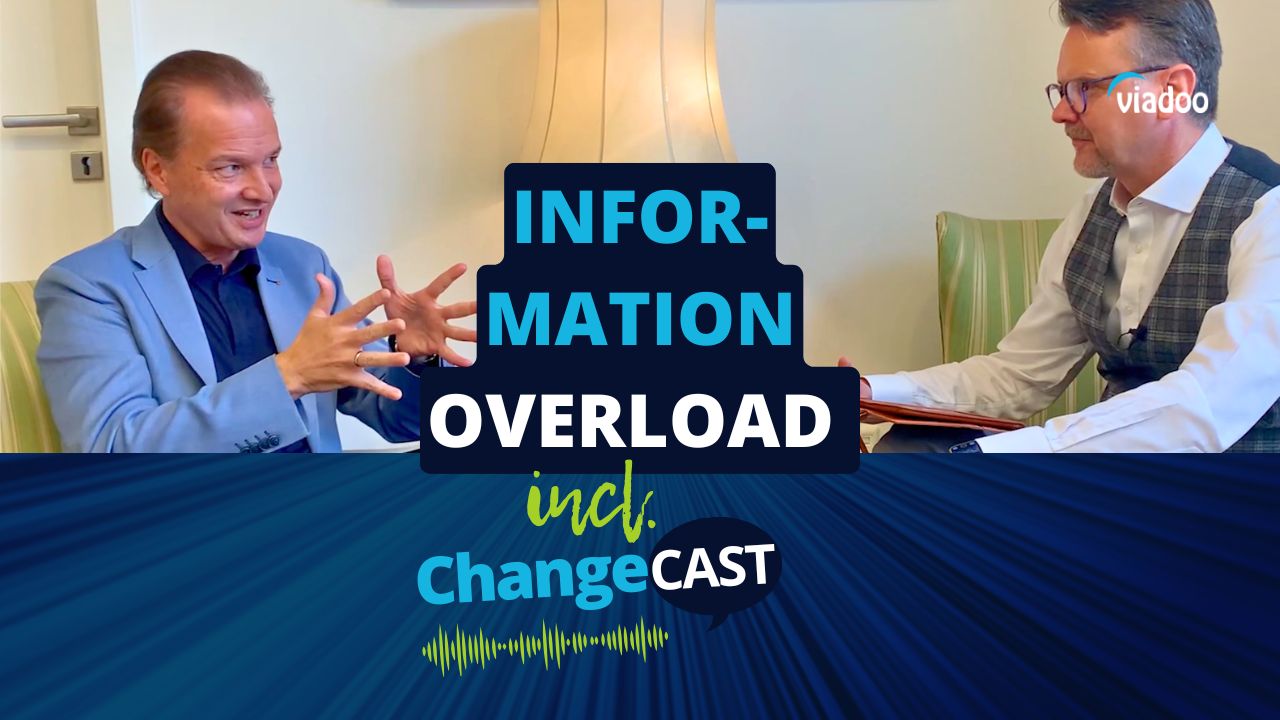
Information and communication are crucial to the success of change projects. However, transparency should not cause additional anxiety. That is why we at viadoo Change Guides pay particular attention in complex projects to when we communicate which messages, in what form, through which channels, and to whom. We discussed information overload and other topics in the latest episode of our ChangeTALK with Prof. Dr. Matthias Müller-Reichart. He holds the Chair of General Business Administration with a focus on risk management at the Wiesbaden Business School. A key insight: Over the past few centuries, people have become increasingly risk-averse in their perception of risk. This means they evaluate negative developments much more drastically than positive ones (reflection effect). This fact should be taken into account in change management and change communication.
How our brain processes information
The increased aversion to change in general and negative developments in particular is also driven by the structure of the human brain. That is why we place great emphasis on storytelling and narrative methods in change initiatives. For anyone who wants to convince people must reach their hearts, and the path to that runs through the brain. There, information first reaches the amygdala at a speed of 0.07 seconds, where, so to speak, mistrust is rooted. In this brain region, the emotional classification of dangers or problems takes place; fear is triggered, and resistance has its roots.
The same information reaches the prefrontal cortex 0.03 seconds later (i.e., only after 0.1 seconds in total). This is where trust is essentially located, and where the experiences are stored upon which we humans base our rational decisions. Depending on the experiences we have already gathered in our lives, either trust or distrust ultimately prevails.
When too much information overwhelms reason
Prof. Dr. Matthias Müller-Reichart examines this aspect from the perspective of behavioral risk management and statistics, among other fields: “From a purely mathematical standpoint, our fears should actually be decreasing,” he says. After all, the probability of war, famine, or other negative developments has de facto decreased here in Germany. However, due to the negative spin of the information we receive through the media, the limbic system overrides the frontal cortex. Thus, emotion triumphs over reason.
The latest Fear Barometer from R+V Insurance provides empirical evidence of this. According to the survey, Germans are most afraid of a more dangerous world caused by U.S. President Donald Trump, who remains in office until January 2021. Professor Müller-Reichart sees the main reason for this fear in the frequent coverage of such topics in the media. A classic information overload. In this way, people worry on a daily basis, so to speak, about what else might happen, including fears of new armed conflicts.
The risk of fear and information overload
What conclusion can be drawn from this insight for successful change management? Can information overload harm the success of change initiatives? That is a difficult question, admits Prof. Dr. Matthias Müller-Reichart in a conversation with ChangeTALK host @doctorchange: “Fundamentally, I am a fan of maximum transparency. And transparency is necessary to make the right decisions. On the other hand, we have to say: The more transparent a situation is, the more both its positive and negative elements come to the fore.”
If maximum transparency reveals a clear preponderance of negative aspects, then that frightens people. “I don’t mean to say, however, that it would sometimes be better to provide less information. But let’s be honest: In the past, due to the more limited media options at the time, the readings on the fear barometer were significantly lower.” Of course, this can also be interpreted to mean that Goethe’s saying “What I don’t know doesn’t bother me” still holds true.
We at viadoo therefore always ensure in complex projects that the amount of information provided aligns with the respective corporate culture and remains the responsibility of management.
Highlighting opportunities amid change
Every change initiative involves risks. This isn’t just the well-known risk of failure, which befalls around 70 percent of change initiatives. Prof. Müller-Reichart explains: “By definition, risk is the failure to achieve a planned target state.” However, a target state can be either missed (which is considered a risk) or exceeded (which is considered an opportunity). Therefore, it is the task of both risk management and change management to positively influence people “so that they perceive change as an opportunity and not as a risk.”
To this end, the holder of the Chair of General Business Administration with a focus on risk management recommends highlighting the positive aspects of change initiatives. We at the change consulting firm viadoo do this in various ways. For example, we make it clear that change does not automatically mean losses, but can also mean gains.
ChangeCAST with Prof. Müller-Reichart (Video)
Why does change communication fail so often – and which risks are regularly underestimated in transformation projects? In this episode of viadoo ChangeTALK, we discuss exactly this topic. Our guest: Prof. Dr. Matthias Müller-Reichart, holder of the Chair of General Business Administration with a focus on risk management. In conversation with viadoo founder @doctorchange, we explore the risks that arise in change communication, why they are so critical to the success of change projects, and how companies can reduce resistance, misunderstandings, and delays through professional, forward-looking communication – without information overload. Concise. Practical. With a scientific perspective.
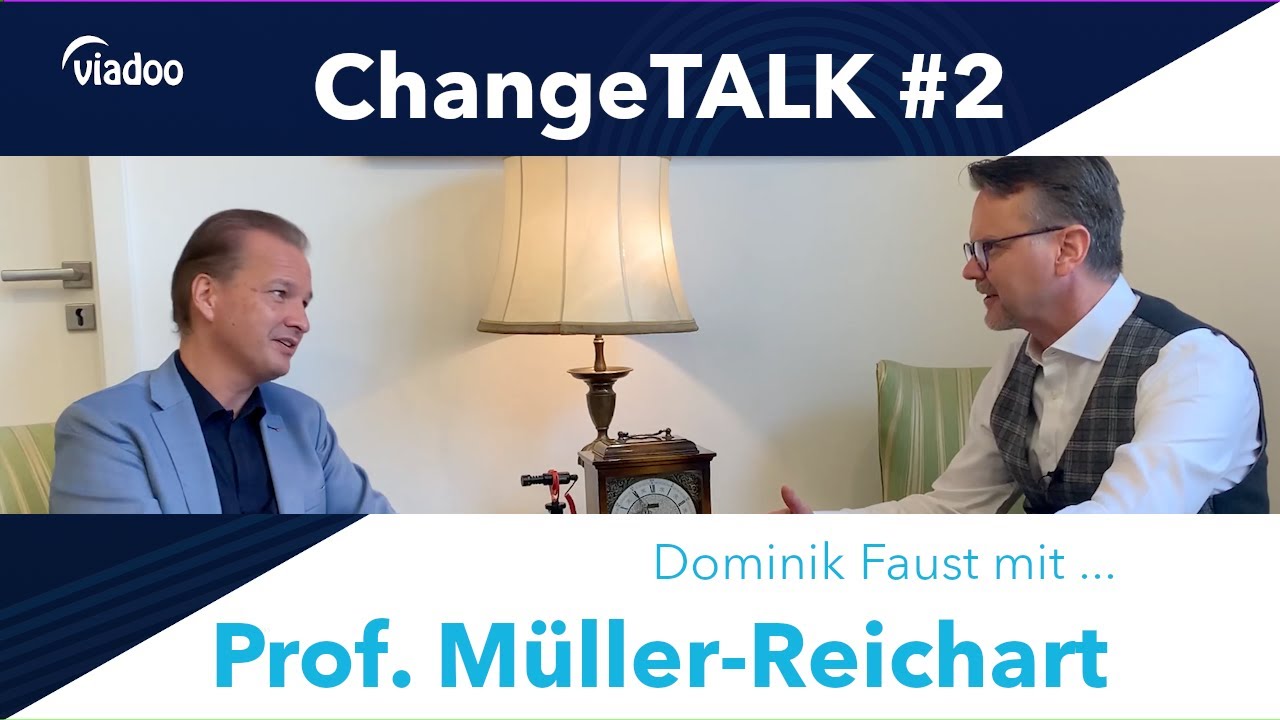
Photo: © Faust / viadoo GmbH
Author(s)

Dr. Dominik Faust verfügt über umfassende Erfahrung in der Führung komplexer, funktionsübergreifender Initiativen an der Schnittstelle von Transformation, Governance und Kommunikation (P&L-Verantwortung > 6 Mio. €). Als Gründer der viadoo GmbH unterstützt er seit vielen Jahren Führungskräfte aus KMUs und DAX-Konzernen operativ bei der Planung und erfolgreichen Steuerung anspruchsvoller Projekte. Dazu gehören M&As (Post-Merger Integration), Restrukturierungen oder Projekt-Recovery.